
 SkillBridge
Personal learning. African ambition.
A personal AI teacher. Inside the learner’s curriculum.
SkillBridge connects lesson questions, explanations and practice in one learning journey. Starting with Rwanda’s secondary curriculum, with the ambition to reach learners across Africa.
SkillBridgeThe problem
A classroom lesson can’t answer every question.
A student gets stuck at the step they don’t understand. Personal attention is scarce, and the need is growing.
External evidence15Madditional teachers needed
Sub-Saharan Africa · primary + secondary · by 2030
UNESCO · 2024 reportSkillBridgeThe solution
Turn an unanswered question into a learning loop.
Ask inside the lesson. Work through an explanation. Try a changed question and review the mistake. Choose the next study step from your curriculum.
- 01
Understand the step.
Ask and follow up inside the lesson.
- 02
Try it yourself.
Use a changed question and read the feedback.
- 03
Choose what comes next.
A study plan connected to the enrolled curriculum.
SkillBridgeThe product
Watch the question become a conversation.
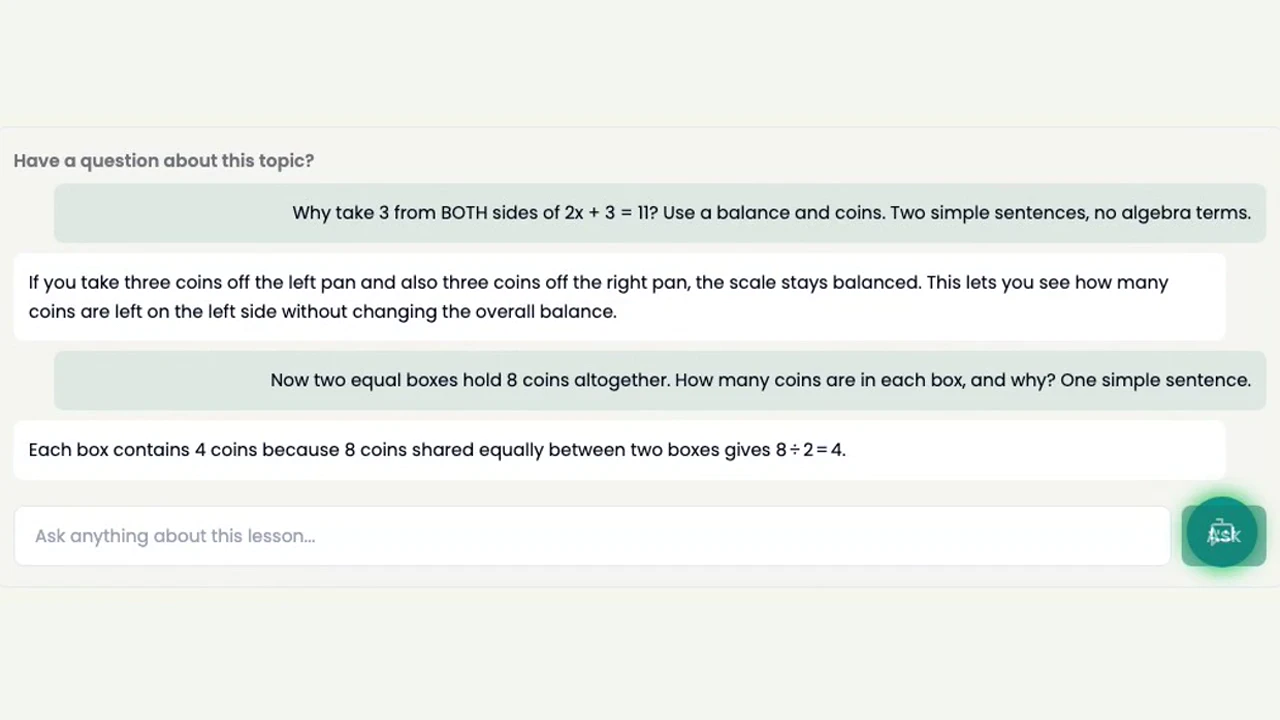
A learner asks why both sides must change. The AI uses a balance and coins. A follow-up turns eight coins into two equal groups.
- 01
Keep both sides equal.
Take three coins from each side of the balance.
- 02
Ask another way.
Eight coins. Two equal boxes. Four coins in each.
 SkillBridge
Why now
AI tutoring has moved beyond the lab.
A teacher-guided trial in Nigeria reported +0.31 SD on a combined skills assessment in six weeks. The next challenge is making it useful in each learner’s curriculum.
External evidence+0.31standard deviations
Nigeria · teacher-guided trial · 6 weeks · combined assessment · external study
World Bank study · 2025SkillBridgeThe learning loop
Pilot-ready. Now prove that learners come back.
The team is ready to pilot. Paying customers: none yet. Next, measure first-session completion, independent practice and repeat use before making a growth or revenue claim.
- 01
Ready to pilot.
Working product; pilot readiness confirmed by the founder.
- 02
No paying customers yet.
Commercial demand remains to be tested.
- 03
Measure the next stage.
First-session completion, independent practice and repeat learning.
SkillBridgeThe market
Start with Rwanda. Build for millions.
Begin with Rwanda’s secondary curriculum. Expand country by country across a region with 81.4 million secondary pupils.
External evidence81.4Msecondary pupils enrolled
2024 secondary enrolment · Sub-Saharan Africa · Rwanda: 901,617 pupils
World Bank / UIS · 2024SkillBridgeProposed business model
One first route. Two commercial hypotheses to test.
Proposed first route: a school-supported Rwanda mathematics pilot. Test paid school continuation after useful adoption. Keep learner subscriptions as a second hypothesis, with pricing and delivery cost still to validate.
Evidence pending · internal draft- 01
Start school-supported.
A focused Rwanda mathematics pilot is the proposed entry route.
- 02
Test paid continuation.
Use a real offer; verify who decides and pays.
- 03
Then test direct subscriptions.
A second hypothesis, after access and costs are understood.
SkillBridgeProposed route to market
Earn distribution through one useful classroom workflow.
Introduce the teacher. Help learners reach their first lesson question. Observe repeat use and the support required. Test school continuation before expanding the rollout.
- 01
Reach a first useful moment.
Teacher introduction, learner setup, one lesson question.
- 02
Observe what happens next.
Independent practice, repeat use and support required.
- 03
Test continuation.
An actual school offer before a wider rollout.
SkillBridgeOur differentiation thesis
Earn preference in one curriculum and classroom workflow.
AI learning tools already exist. Our proposed wedge is Rwanda’s curriculum with connected learner and teacher work. The pilot must show why people choose it over their current alternatives.
Evidence pending · internal draft- 01
Khanmigo
Guided AI learning and teacher tools.
- 02
M-Shule
AI-assisted learning across messaging and web channels.
- 03
SkillBridge’s test
Rwanda lesson, practice and classroom continuity in one experience.
SkillBridgeThe team
Three people. A working product. A pilot ahead.
Emre, Naol and Mikiyas are the team behind SkillBridge. The next step is to pair working product evidence with observed learner and teacher use in a focused pilot.
Evidence pending · internal draftNaol
Mikiyas
SkillBridgeBuild the next stage
$750K to prove the next stage of learning.
Proposed raise: US$750,000. Fund the pilot, strengthen learning quality and test a repeatable school offer. Turn a working product into evidence of independent use, return and paid demand.
Evidence pending · internal draftContact destination pending verification
- 01
Learning quality.
Observe whether learners can apply an explanation to a new question.
- 02
Repeat learning.
Measure first-session completion and return over a defined cohort window.
- 03
A repeatable offer.
Test school continuation, support requirements and delivery cost.
SkillBridgeEvidence appendix
Make every learning and traction number defensible.
Keep academic outcomes, activity, retention, payments, and revenue distinct. Define the cohort, time window, source, and exclusions behind each result.
Evidence pending · internal draft—ActivityEvidence pending
—CohortEvidence pending
—PaymentEvidence pending
SkillBridgeEvidence appendix
Turn enrolment scale into a reachable-market model.
Start with dated pupil counts. Apply curriculum coverage, device access, distribution reach, and validated net prices. Count overlapping learner and school channels once.
Evidence pending · internal draft01PopulationInputs pending
02EligibilityInputs pending
03Net pricingInputs pending
SkillBridgeEvidence appendix
Make each channel earn its economics.
Test learner and school pricing, AI delivery cost, acquisition cost, and renewal separately. Expansion needs evidence that the model can sustain the service.
Evidence pending · internal draftLearner channelSchool channel
SkillBridgeEvidence appendix
One ambition. A clear boundary around today’s proof.
Today: Rwanda curriculum and demonstrated AI-supported web workflows. Next: validated learning impact, adoption, and delivery. Each new market needs its own curriculum and distribution evidence.
Current productProposed pilotsAfrica ambition